
NavIC consists of a constellation of seven satellites and a network of ground stations and is touted to be more accurate than GPS.

"I am extremely happy to announce that GSLV Mark III successfully injected Chandrayaan 2 in the defined orbit, infact the orbit is 6,000 km more than what was intended," Sivan said.

Over 32 missions -- satellites and rockets -- have been planned for the year.

Friday's mission is the fourth operational flight of LVM3 which aims to launch the Chandrayaan-3 spacecraft into a Geo Transfer Orbit.

A key feature of the satellite is providing mobile communication to India through multi beam coverage facility.

'It is a blessing in disguise that they could find the glitch before the launch.' 'If this was not found, the entire mission would have been lost.'

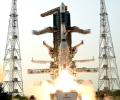
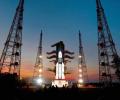
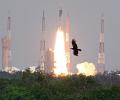
The 43.43 metre tall rocket lifted off at 5.28 pm from the second launch pad at the Satish Dhawan Space Centre in Sriharikota
'If Chandrayaan 1 had a launch with GSLV, we need not have an orbiter for Chandrayaan 2.' 'We could have gone straight round the moon and landed on the moon.'

And the first Indian to go into space from 'Indian soil' could well be a woman.

'India has got a unique opportunity to get more and more business from outside as India is cost-effective and reliable.'

It has already tasted success with the moon mission and Mangalyaan. Is man in space the next frontier for ISRO?

The mission life of the 2,250kg GSAT-7A, built by ISRO, is eight years. It will provide communication capability to users in Ku-band over the Indian region.

India's heaviest rocket ever is expected to take to the sky next January on an experimental flight whose later versions could be used to send humans on space missions.

The 3,423 kg GSAT-29 carries Ka and Ku band high throughput transponders intended to meet the communication requirements of users, including in the North East and in Jammu and Kashmir.

The rocket is almost 49 meters high -- as much as a 17-floor building. It weighs 415 tons -- as much as the combined weight of 80 full grown elephants.

The heaviest rocket of the Indian Space Research Organisation -- LVM3-M2/OneWeb India-1 -- blasted off from the Sriharikota spaceport on Sunday to place 36 broadband communication satellites into the Low Earth Orbit (LEO) for a UK-based customer.

The Indian Space Research Organisation successfully launched India's fifth navigation satellite IRNSS-1E from Sriharikota.

An industrial house bred in old-school manufacturing values, Godrej & Boyce has displayed unusual agility to become a trusted builder of advanced weaponry, discovers Ajai Shukla.

'When the Americans are talking about colonising Mars by 2030, India cannot be lagging behind.'

A recap of events that occurred in India in the past 24 hours.

PSLV C-29 blasted off from the Satish Dhawan Space Centre, about 110 km from Chennai, at 6 pm and released the six satellites one by one into a 550 km circular orbit.

He said India wanted growth, development and peace in the region and was keen to utilise technology to pursue this goal for the shared prosperity.
The BJP hit back accusing the Congress of drawing the issue into political arena.

A truly 'made in India' satellite that will empower a digital India.
NASA said it is looking forward to explore the solar system with its Indian counterpart.

Although Russia, United States and China have achieved a soft landing on the lunar surface, India is aiming at becoming the first one to explore the south pole of the Moon.
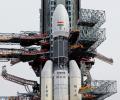
'It is time we Indians learnt to believe in ourselves, and stopped questioning our own capabilities every time a space launch is not a glorious success,' says M D Riti.

We sorted through countless photographs taken around the world to come up with the top photos of 2019. Together these images tell the story of the year -- capturing moments of hope and heartbreak, triumph and tragedy.

India, with its demonstrated capabilities of undertaking low cost high value inter-planetary travel, offers great opportunities for NASA to work with.

The year 2014 has been an eventful one for India. The country got a new government and a new state, broke new frontiers in various fields and of course its share of controversies.

Other than the Cartosat-2 series satellite, the PSLV is carrying 29 nano satellites from 14 countries - Austria, Belgium, Chile, Czech Republic, Finland, France, Germany, Italy, Japan, Latvia, Lithuania, Slovakia, the United Kingdom and the United States of America besides a nano satellite from India.
ISRO chairman A S Kiran Kumar talks of what's on and what lies ahead for the Indian space agency.

Dr P K Menon, Chief Scientist and CEO, Optimal Synthesis Inc, who worked with Dr A P J Abdul Kalam early on in his career, recalls what it was like working for his first boss.

'What we are trying for is to make space travel easier like air travel.' 'We have already established ourselves... the fact that other countries are coming to seek our help shows our technology is mature.'
 © 2026 Rediff.com - Advertise with us - Disclaimer - Privacy Policy - Sitemap - Feedback - About us - Terms of use - Grievances